

The 2026/27 La Liga season begins with an intriguing contest as Sevilla welcome Rayo Vallecano to the Ramón Sánchez-Pizjuán Stadium on Saturday, August 15, 2026. Kickoff is scheduled for 7:30 PM Universal Time (19:30 UTC). The evening timing makes this opening-weekend fixture convenient for international viewers who want to enjoy Spanish football on a Saturday. With both teams eager to start the new campaign positively, the match promises intensity, tactical intrigue, and an energetic atmosphere in Seville.
Opening-day matches always carry extra significance because they provide the first real indication of how a team has developed during the summer. Preseason performances can offer useful clues, but competitive football creates a different level of pressure. Sevilla will want to make full use of home advantage and give their supporters an encouraging first impression. Rayo Vallecano, meanwhile, will arrive without the same expectations as their hosts, which may allow them to play with freedom. Three points in August do not decide an entire season, but a strong start can build confidence, settle new players, and create early momentum.
For Sevilla, the Ramón Sánchez-Pizjuán has traditionally been a demanding venue for visiting teams. The crowd stays close to the action and expects the home side to play assertively, particularly against opponents that may spend long periods defending. Sevilla will therefore be under pressure to control possession, move the ball quickly, and create chances before Rayo can settle into a compact structure. Patience will also be important. If the opening goal does not arrive early, the hosts must avoid forcing passes or leaving unnecessary gaps behind their midfield. Their ability to combine ambition with defensive balance could determine the direction of the match.
Rayo Vallecano are unlikely to travel to Seville simply to protect a draw. The Madrid club have built a reputation for competing with courage, pressing aggressively, and making matches uncomfortable for technically stronger opponents. Their approach could be especially effective in the first game of a new season, when coordination and fitness levels are not always perfect. If Rayo can disrupt Sevilla’s buildup, win second balls, and attack immediately after turnovers, they may create opportunities before the home defense is properly organized. Their greatest challenge will be sustaining that intensity in the heat and managing the spaces that appear when the press is beaten.
The midfield battle should be one of the most important areas of the contest. Sevilla will probably look to establish territorial control and circulate possession from side to side, searching for openings between Rayo’s defensive lines. Rayo may respond by narrowing the center, challenging every loose ball, and directing Sevilla toward wider areas. This would turn the match into a test of crossing quality, movement inside the penalty area, and recovery positioning. Whichever side wins the midfield duels will be better placed to control the tempo. It could also decide whether the game becomes measured and technical or fast, physical, and unpredictable.
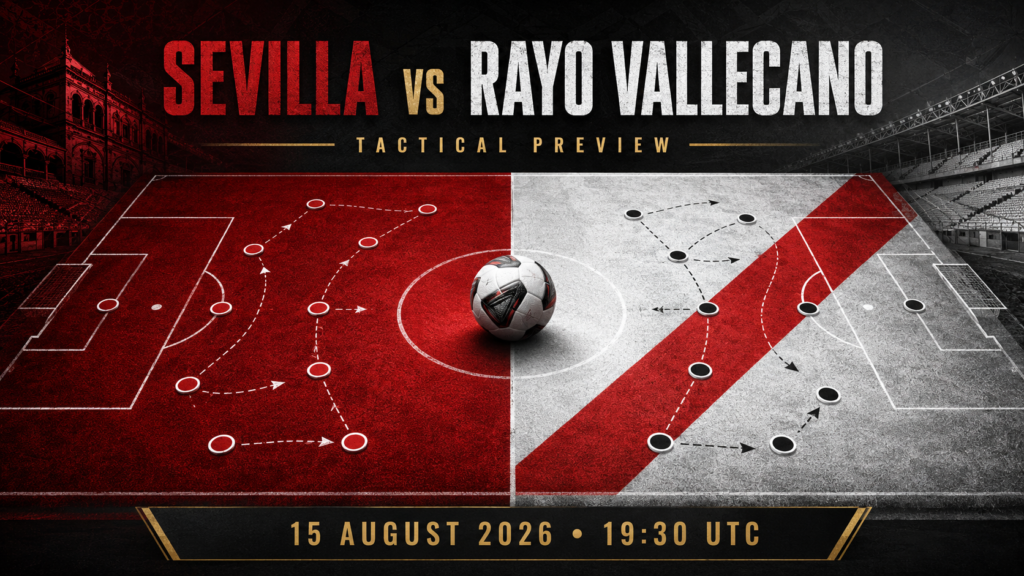
Another key question is how Sevilla handle transitions. Committing players forward can help them overload Rayo’s defense, but it may also expose space behind the full-backs. Rayo will look for those moments, particularly when a Sevilla attack ends with a misplaced pass or blocked cross. A direct run, an early forward pass, or a quick switch of play could suddenly turn defense into a dangerous counterattack. Sevilla’s deeper midfielders must recognize the risk and provide protection before possession is lost. Strong counter-pressing could keep Rayo pinned back; weak counter-pressing could give the visitors their clearest path to goal.
Set pieces may also have an outsized influence, as they often do early in a season. Teams are still developing their rhythm in open play, so corners and free kicks can provide a more rehearsed route to scoring. Sevilla will hope to use the noise of the home crowd and pressure inside the box to make dead-ball situations count. Rayo, however, can also threaten from carefully planned deliveries and second-phase attacks. Discipline near the penalty area will be essential for both teams. A careless foul or poorly defended corner could decide a tight match even if one side controls most of the possession.
From a psychological perspective, Sevilla carry the heavier burden. Playing at home creates opportunity, but it also creates expectation. If they score first, the stadium can help them increase the pressure and force Rayo to take greater risks. If Rayo score first, frustration may grow and the visitors can become even more compact. Rayo’s ideal scenario would be to stay organized through the opening stages, quiet the crowd, and make Sevilla question their attacking decisions. Sevilla’s ideal scenario would involve an aggressive but composed start, an early series of chances, and enough defensive security to prevent the visitors from gaining belief.
International viewers should note that Spain will be observing Central European Summer Time in August. Therefore, the confirmed 9:30 PM kickoff in Seville corresponds to 7:30 PM Universal Time, written in the 24-hour format as 19:30 UTC, on the same Saturday. Using UTC provides one consistent global reference and avoids confusion between regional time zones. Viewers should still check their local listings close to kickoff because broadcast arrangements and channel schedules can be updated.
Supporters should also be careful when evaluating early-season team news. Summer transfer activity, late fitness tests, and registration decisions can affect the starting lineups right up to matchday. Rather than depending entirely on individual names, the broader tactical questions may be more revealing. Can Sevilla create clear chances against a disciplined block? Can Rayo escape pressure without repeatedly surrendering possession? Which team will adapt more effectively if the original plan fails? Substitutions may be particularly influential because fresh legs can change the speed of the contest during the final half hour.
In terms of the likely match pattern, Sevilla should see more of the ball, while Rayo will try to convert pressure into opportunities through pressing and transitions. The hosts may need time to break through, especially if the visitors defend their penalty area with concentration. Rayo’s chances could be less frequent but more direct. That contrast should create an absorbing tactical contest: Sevilla attempting to establish control and Rayo trying to prevent that control from becoming comfortable. The first goal will be crucial because it would allow the scoring team to shape the game around its preferred strengths.
This fixture is more than a routine season opener. For Sevilla, it is a chance to set a confident tone at home and demonstrate that they can handle expectation with maturity. For Rayo Vallecano, it is an opportunity to make an immediate statement away from Madrid and show that their energy can trouble established opponents. The result may depend on small details—one successful press, one accurate set-piece delivery, or one defensive mistake. Whatever the outcome, Sevilla versus Rayo Vallecano offers international fans an appealing introduction to La Liga 2026/27, with a Saturday evening kickoff in UTC and two ambitious teams ready to compete from the first whistle.
Fixture details were verified against the official La Liga schedule and Sevilla FC’s match listing. The confirmed 9:30 PM kickoff in Spain converts to 7:30 PM UTC.