
If you are asking, “What time is the solar eclipse on August 12?” the short answer is that the 2026 eclipse reaches its greatest point at about 5:45:54 p.m. UTC on Wednesday, August 12. However, there is no single local time for everyone. The exact start, maximum, and end times depend on where you are watching from. In Iceland, the main event happens in the late afternoon. In Spain, it happens in the evening, shortly before sunset. Some places in North America see only a small partial eclipse earlier in the day, while many other areas cannot see it at all.
The August 12, 2026 event is a total solar eclipse. Totality will be visible only inside a narrow path crossing northern Russia, Greenland, Iceland, the Atlantic Ocean, Spain, and a small part of Portugal. A wider area, including most of Europe and parts of North America and northwestern Africa, will see a partial eclipse.
What Time Is the Solar Eclipse on August 12 in UTC?
The most important global time is 17:45:53.8 UTC, or about 5:45:54 p.m. UTC. According to eclipse calculations published by NASA’s Goddard Space Flight Center, this is the instant of greatest eclipse. At that moment, the axis of the Moon’s shadow passes closest to the center of Earth. Near the center of the eclipse path, totality can last for up to about 2 minutes and 18 seconds.
Across Earth, the first partial phase begins at approximately 3:35 p.m. UTC and the last partial phase ends at about 7:59 p.m. UTC. One location sees only part of this worldwide timeline.
Solar Eclipse Times by Location
NASA lists local eclipse times for selected cities. In Reykjavík, Iceland, the partial eclipse begins at 4:47 p.m. Totality starts at 5:48 p.m. and ends at 5:49 p.m. In León, Spain, the partial phase starts at 7:32 p.m., while totality runs from about 8:28 p.m. to 8:30 p.m. Valencia sees totality from around 8:32 p.m. to 8:33 p.m., and Zaragoza sees it from approximately 8:29 p.m. to 8:30 p.m. All of these are local times.
London will see a deep partial eclipse rather than totality. It starts at about 6:17 p.m., reaches 91% maximum coverage at 7:13 p.m., and ends near 8:06 p.m. Dublin’s eclipse peaks at 7:10 p.m. with about 94% coverage.
In New York City, the partial eclipse begins at approximately 1:07 p.m. EDT, reaches its maximum at 1:54 p.m., and ends at about 2:38 p.m. Only around 9% of the Sun will be covered. Anchorage, Alaska, sees the eclipse from about 7:36 a.m. to 9:09 a.m., with the maximum at 8:21 a.m. Check an official eclipse map for your exact address because nearby cities can have different times and coverage.
Where Will the August 12 Solar Eclipse Be Total?
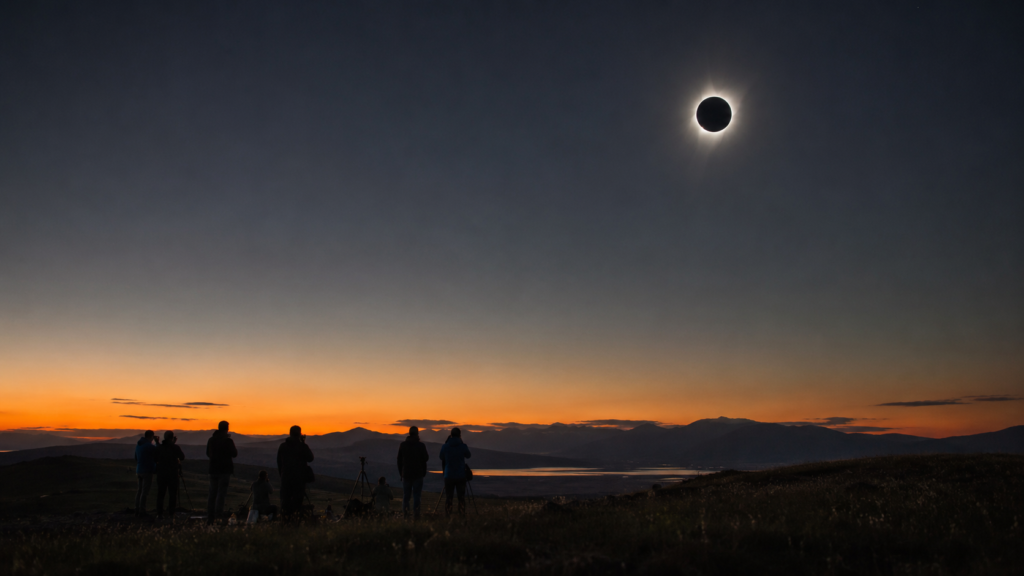
A total eclipse happens only where the Moon’s dark inner shadow, called the umbra, touches Earth. On August 12, 2026, it crosses the Arctic, Greenland, Iceland, the North Atlantic, northern Spain, and a small corner of Portugal. Viewers must be inside this narrow path to see the Sun become completely covered.
Being close to the path is not enough. A location with 99% coverage still has a partial eclipse, not totality. During totality, the sky darkens and the Sun’s outer atmosphere, called the corona, becomes visible.
In Spain, the Sun will be low in the western sky and totality will happen shortly before sunset. Viewers need an open western horizon. Weather also matters because thick clouds can hide the event.
Can You See the Eclipse From the United States?
The United States will not experience totality. Parts of the north will see a partial eclipse. NASA’s examples include approximately 28% coverage in Anchorage, 24% in Bangor, 16% in Boston, 9% in New York City, and 4% in Washington, D.C.
Before planning, enter your location into a trusted eclipse calculator. Do not assume the eclipse is visible simply because it happens on that date.
Is the August 12 Solar Eclipse Visible in India or the UAE?
The eclipse is not visible from India or the United Arab Emirates. In Dubai and most of Asia, it cannot be observed in the sky.
People outside the visibility zone can watch online. NASA says its live coverage begins at 1:15 p.m. EDT, or 5:15 p.m. UTC and 9:15 p.m. in the UAE.
How to Watch the Solar Eclipse Safely?
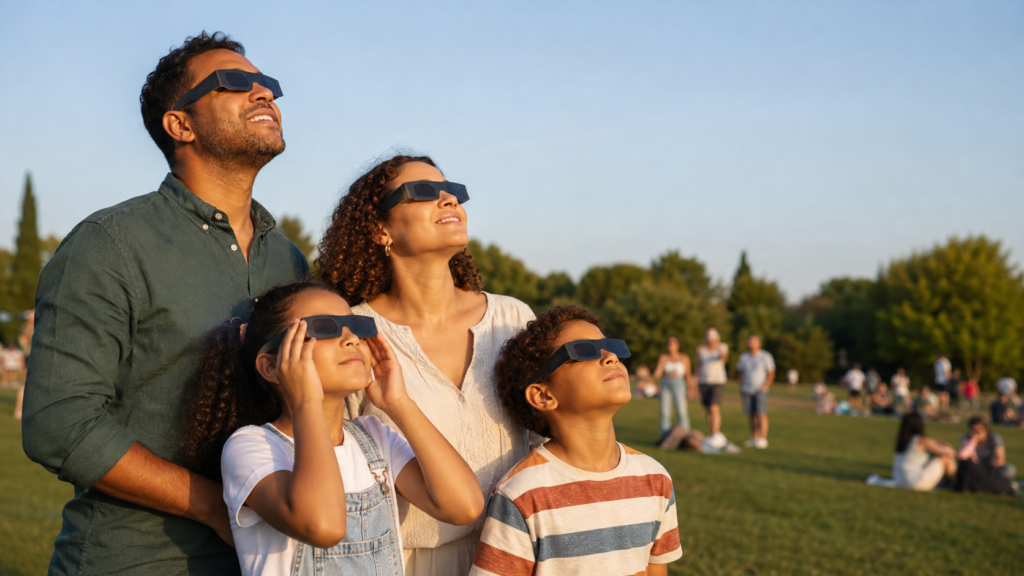
Never look directly at the Sun during a partial eclipse without proper eye protection. Ordinary sunglasses are not safe. Use genuine solar viewing glasses or a handheld viewer that meets the ISO 12312-2 safety standard. Do not use scratched or damaged viewers.
Do not look through a camera, telescope, or binoculars while wearing eclipse glasses. These devices need a special solar filter secured over the front. Without eclipse glasses, use an indirect method such as a pinhole projector.
Only people inside the path of totality may briefly remove their glasses when the Sun is completely covered. Put them back on as soon as any bright part returns. Outside the totality path, protection must remain on throughout the event. Always supervise children. These precautions follow NASA eclipse safety guidance and recommendations from the American Astronomical Society.
Why Does the Eclipse Time Change by City?
The Moon’s shadow moves while Earth rotates, so locations enter and leave it at different moments. Time zones add another difference: 5:45 p.m. UTC is 6:45 p.m. in the UK during British Summer Time and 7:45 p.m. in mainland Spain during summer time. A city’s local maximum can also differ from the global maximum.
Use UTC as a global reference, but follow a city-specific timetable for viewing. Arrive 30 to 60 minutes before the partial phase begins.
Frequently Asked Questions
| Q. What Time Is the Maximum Solar Eclipse on August 12, 2026? A. The eclipse reaches its greatest global point at approximately 5:45:54 p.m. UTC. Your local maximum may happen at a different time. |
| Q. How Long Will Totality Last? A. The maximum duration is about 2 minutes and 18 seconds near the center of the eclipse path. In many cities, totality lasts less than two minutes. |
| Q. Is the Eclipse Total Everywhere? A. No. Totality is visible only inside the narrow path crossing northern Russia, Greenland, Iceland, the Atlantic Ocean, Spain, and a small part of Portugal. Other places may see a partial eclipse or no eclipse. |
| Q. Do I Need Eclipse Glasses When the Sun Is 99% Covered? A. Yes. Even 99% coverage is still a partial eclipse. Proper solar eye protection is required whenever any bright part of the Sun is visible. |
Final Answer
The August 12, 2026 solar eclipse reaches its greatest point at about 5:45:54 p.m. UTC. Totality occurs later in the local day in Iceland and during the evening in Spain, while parts of the United States and Canada see a smaller partial eclipse earlier in their local day. Check the exact time for your city before going outside, choose a location with a clear view, and use certified solar viewing protection throughout every partial phase. For more interesting topics you can read lifestyle content anytime from anywhere.
Fact-check note: Timings and visibility details were reviewed against NASA’s August 12, 2026 eclipse page and NASA Goddard eclipse calculations. Eye-safety guidance follows NASA and the American Astronomical Society. Last updated: August 12, 2026.